
Conveyor Monitoring System
LubeVision
Conveyor Chain Monitoring

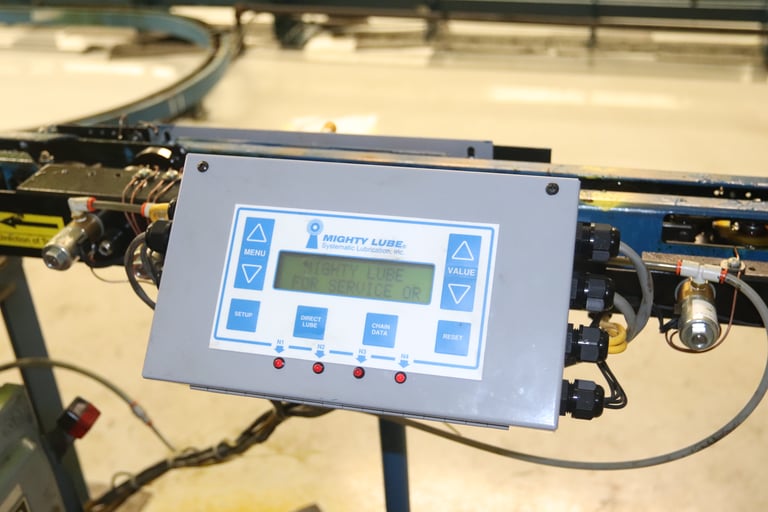
Automatic chain lubrication systems can reduce conveyor downtime by up to 60% while extending equipment life through precise, consistent lubricant delivery that eliminates the inefficiencies of manual maintenance.
Conveyor chain wear is an inevitable consequence of continuous mechanical operation. As chains move through production cycles, metal-to-metal contact at pin-and-bushing interfaces generates friction and heat, leading to gradual material loss, elongation, and eventual failure. In manufacturing facilities where conveyors operate around the clock, this wear accelerates exponentially when lubrication is inconsistent or inadequate. The hidden costs of unmonitored chain wear extend far beyond replacement parts: unplanned downtime disrupts production schedules, emergency repairs consume valuable labor resources, and catastrophic failures can compromise workplace safety.
Manual lubrication approaches introduce significant variability into conveyor maintenance programs. Technicians applying lubricant by hand face challenges with coverage consistency, proper timing relative to conveyor operation, and precise delivery to critical wear points such as chain pins and trolley bearings. Environmental factors including temperature fluctuations, moisture exposure, and airborne contaminants further compromise lubrication effectiveness. These variables create conditions where some chain sections receive excessive lubricant while others remain under-protected, accelerating uneven wear patterns that reduce overall conveyor chain life.
Automatic conveyor lubrication systems fundamentally transform this maintenance challenge by delivering precise, metered amounts of lubricant directly to critical friction points at programmed intervals. Unlike manual methods that depend on technician availability and judgment, automated systems ensure every lubrication cycle occurs exactly when needed, regardless of shift schedules or staffing constraints. This consistency proves particularly valuable in overhead conveyor lubrication applications where access difficulties make manual application impractical. By eliminating human variability from the lubrication equation, automatic systems establish the foundation for predictable conveyor chain performance and extended equipment life across entire production operations.
The effectiveness of conveyor chain lubrication depends not merely on lubricant quantity, but on precise delivery to specific wear surfaces where metal-to-metal contact occurs. Chain pins and trolley bearings represent the primary friction interfaces in conveyor systems, and these components require targeted lubrication to prevent accelerated wear. Advanced automatic conveyor lubricator technology utilizes strategically positioned delivery points that apply lubricant directly to pin-bushing interfaces as the chain passes, ensuring optimal penetration and surface coverage. This precision targeting maximizes lubricant effectiveness while minimizing waste, a critical advantage in high-speed production environments.
Mighty Lube offers a range of conveyor chain lubrication systems engineered to match different chain speeds, load profiles, and operating environments. Across single-point, multi-point, and condition-responsive configurations, these systems deliver controlled lubricant volumes at programmable intervals and can be set to apply lubricant only during active conveyor operation. This flexible approach helps ensure consistent lubrication of critical wear surfaces, even in manufacturing environments with fluctuating speeds, intermittent duty cycles, and changing operating conditions.
Food-grade conveyor lubricant applications demand additional considerations for product safety and regulatory compliance. Mighty Lube's specialized food-grade conveyor lubricants meet FDA and NSF standards for incidental food contact while delivering superior protection against wear and corrosion. Automatic application of these formulations through precision conveyor chain lubricator systems reduces contamination risk compared to manual methods, supporting both equipment reliability and food safety objectives. The combination of advanced lubricant chemistry and precision delivery technology enables food processing facilities to maintain optimal conveyor chain performance without compromising sanitation standards or product quality.
Traditional lubrication methods frequently apply excessive lubricant volumes in an attempt to ensure adequate coverage, resulting in substantial waste and associated environmental concerns. Manual application techniques inherently lack the precision required to deliver optimal lubricant quantities - technicians typically lean toward over-application to compensate for uncertainty about coverage adequacy. This approach generates several negative consequences: wasted lubricant increases operating costs, excess product creates housekeeping challenges, and environmental impact grows unnecessarily. In overhead conveyor systems, excess lubricant drips onto products and floor surfaces, creating contamination risks and safety hazards that require additional cleanup labor.
Automatic conveyor lubrication systems fundamentally alter this cost equation by delivering precisely metered lubricant volumes calibrated to actual conveyor requirements. Mighty Lube's industrial conveyor lubrication technology reduces lubricant consumption by 25-75% compared to manual methods while maintaining superior protection against wear. This reduction stems from multiple factors: programmed delivery intervals eliminate unnecessary application during conveyor idle time, precision metering prevents over-application, and targeted delivery to critical wear points maximizes lubricant effectiveness. Manufacturing facilities implementing automatic lubrication systems report substantial reductions in lubricant purchasing costs alongside measurable improvements in conveyor cleanliness and reduced floor contamination.
The environmental and operational benefits of reduced lubricant consumption extend throughout production facilities. Cleaner conveyor systems minimize product contamination risks and reduce demands on cleaning operations. Lower lubricant volumes decrease waste disposal requirements and associated environmental compliance obligations. Perhaps most significantly, precise lubrication eliminates the buildup and residue accumulation that can interfere with conveyor operation, trigger product quality issues, and necessitate unscheduled maintenance interventions. The integration of automatic conveyor lubrication systems with conveyor monitoring technology enables facilities to optimize lubricant delivery parameters based on actual operating conditions, creating a closed-loop approach to conveyor chain lubrication that continuously improves efficiency and sustainability.
The evolution from standalone automatic lubrication to integrated conveyor monitoring systems represents a fundamental shift in maintenance methodology. While consistent lubrication significantly extends conveyor chain life, combining lubrication automation with real-time conveyor chain monitoring creates unprecedented visibility into equipment condition and performance trends. AI conveyor monitoring technology analyzes multiple parameters including chain wear progression, drive motor amperage, lubrication cycle completion, and trolley condition to identify developing issues before they escalate into failures. This predictive conveyor monitoring capability transforms maintenance from reactive emergency response to proactive condition-based intervention.
Mighty Lube's ChainVision® and OmniView® technologies exemplify advanced conveyor chain wear monitor capabilities that provide link-by-link wear measurement and comprehensive trolley condition assessment. These conveyor monitoring systems capture high-resolution imaging data as chains pass inspection points, enabling precise detection of worn links, cracked components, and pitch elongation. The integrated conveyor predictive maintenance platform correlates wear data with lubrication system performance, revealing relationships between lubrication effectiveness and chain longevity. Manufacturing facilities gain the ability to predict chain replacement timing with precision, transitioning from calendar-based replacement schedules to condition-based strategies that maximize component utilization while preventing unexpected failures.
The integration of AI conveyor maintenance algorithms with real-time monitoring data enables sophisticated predictive analytics that identify subtle performance degradation patterns invisible to manual inspection. Machine learning models trained on historical conveyor performance data recognize anomalies in wear progression, lubrication consumption, and drive load that indicate developing mechanical issues. Maintenance teams receive automated alerts when monitored parameters exceed established thresholds, enabling intervention during planned downtime rather than emergency shutdowns. This convergence of automatic conveyor lubrication technology with AI conveyor monitoring creates a comprehensive conveyor predictive maintenance ecosystem that reduces unplanned downtime by 40-60% while extending equipment life through optimized maintenance timing and resource allocation.
The financial justification for automatic chain lubrication systems becomes compelling when maintenance managers analyze total cost of ownership across conveyor system lifecycles. Initial equipment investment represents only a fraction of lifetime conveyor costs: ongoing expenses including lubricant consumption, maintenance labor, replacement components, and production downtime typically exceed original capital expenditure by factors of five to ten. Automatic lubrication systems impact each of these cost categories simultaneously: reduced lubricant usage lowers materials costs, automated delivery eliminates manual application labor, consistent lubrication extends component life, and predictive maintenance capabilities prevent costly unplanned downtime.
Manufacturing facilities implementing Mighty Lube conveyor lubrication systems report measurable improvements across multiple performance metrics. Conveyor chain life extension of 50-200% is common when facilities transition from manual to automatic lubrication with integrated monitoring. Energy consumption decreases as properly lubricated chains reduce drive motor loads, with facilities measuring 15-30% reductions in conveyor drive power requirements. Maintenance labor productivity improves as technicians shift from routine lubrication tasks to value-added predictive maintenance activities guided by real-time conveyor chain monitoring data. These improvements compound over time, creating substantial return on investment that typically achieves payback within 12-18 months of system implementation.
The strategic value of integrated conveyor monitoring systems extends beyond direct cost reductions to encompass operational flexibility and competitive advantage. Real-time visibility into conveyor health across multiple production lines enables maintenance planning optimization, ensuring critical equipment receives priority attention while stable systems continue operating without unnecessary intervention. Predictive maintenance capabilities reduce spare parts inventory requirements by providing advance notice of component replacement needs, supporting just-in-time procurement strategies that minimize working capital tied up in inventory. Perhaps most significantly, the combination of automatic conveyor lubrication and AI conveyor monitoring positions manufacturing facilities at the forefront of Industry 4.0 transformation, leveraging data-driven insights and automation technology to achieve reliability levels that translate directly into production capacity, quality consistency, and market responsiveness that define competitive excellence in modern manufacturing environments.